Leave your details and we’ll get back to you personally with more information, additional photos or to arrange a viewing.
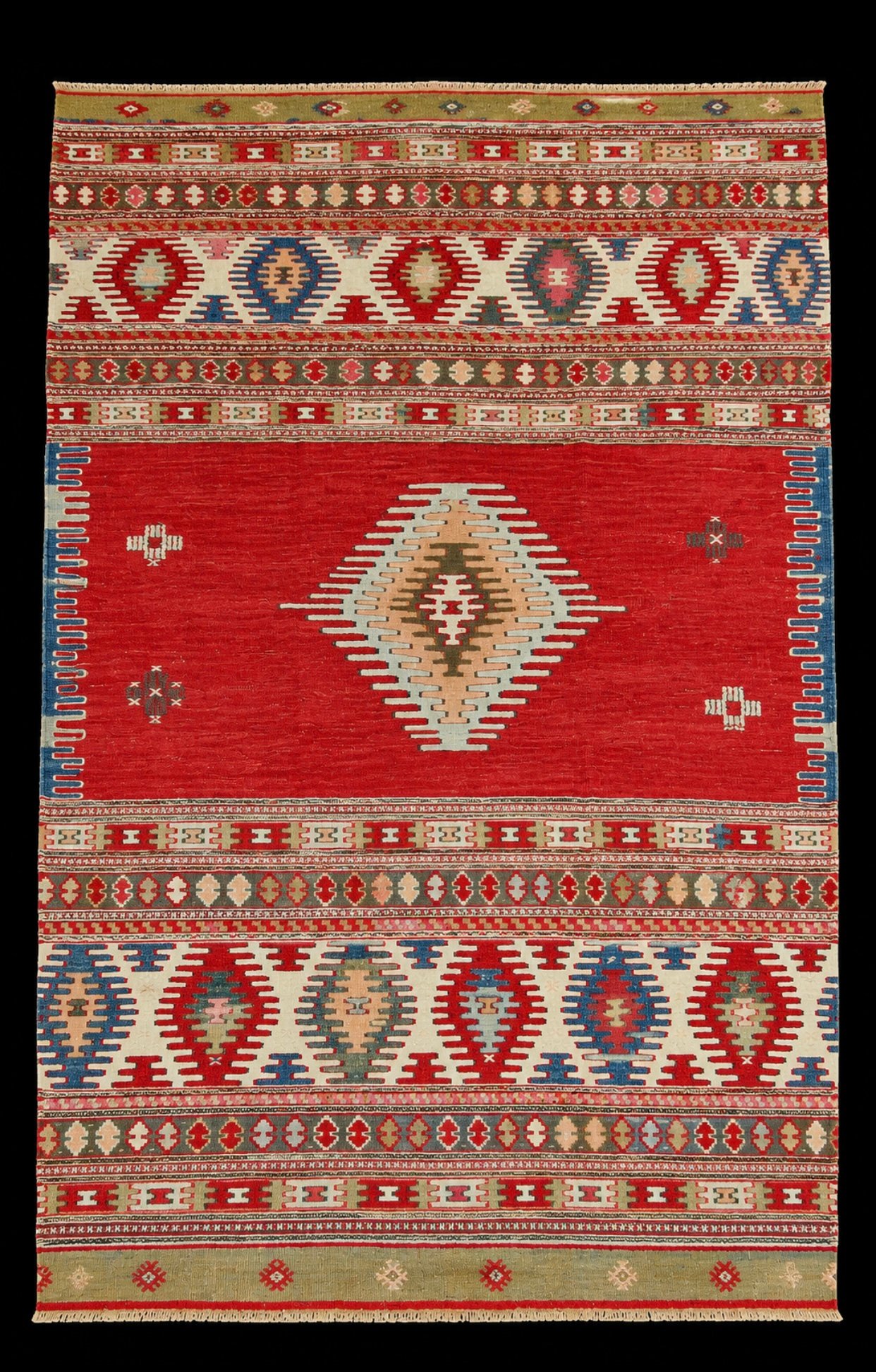
Excellent specimen of this ancient design with bright red vegetable colour field
The word parmaklı comes from the Turkish word parmak, meaning “finger” or the palm of a hand (parmakli translates to “fingered”
They are characterized by long, finger-like extensions or vertical line geometries radiating from central medallions.
Historians link the design to an ancient Anatolian weaving tradition stretching back thousands of years, often woven by local “yerli” or nomadic and settled Turkic tribal groups in the Phrygian Highlands. The weavers of Parmaklı kilims explicitly disassociate themselves from both the Yörük nomads and the local Turkmen tribes who arrived later in Anatolia. The Yerli represent an indigenous, deeply rooted sedentary or semi-sedentary population.
Leading rug scholars, such as Belkıs Balpınar and Udo Hirsch, argue that Parmaklı designs represent a continuous Anatolian weaving lineage that dates back over 3,000 years, drawing direct evolutionary ties to ancient Phrygian textile traditions rather than Central Asian nomadic imports